
When an upper floor is renovated, the slowest part is often not the demolition but getting the waste down. Every bag is carried down the stairs or waits for the lift, and the stairwell fills with dust. A chute solves exactly that.
What it is
A chute is a tube of linked sections, hung one below another on chains. At the top there is a wider opening into which the waste is tipped, and the bottom end reaches the skip. Whatever is tipped in on the upper floor falls straight into the skip.
It is fitted down the outside of the building – through a window or from a balcony – or on the scaffolding, if there is any.
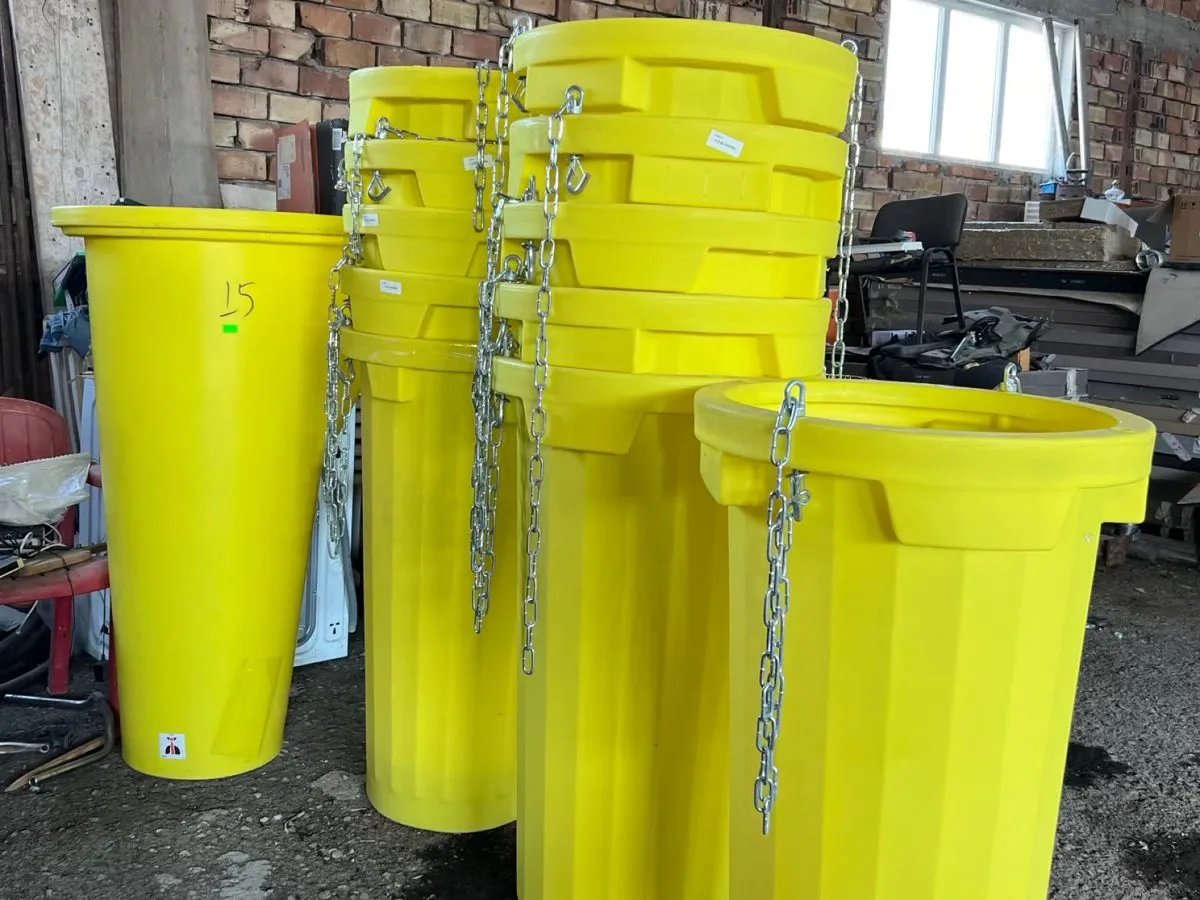
The sections of the chute with the chains on which they hang one below another.
When it is worth it
- Renovating the first floor and above, when tiles, plaster, screed or walls come out and there is a lot of waste.
- Roof repairs – the old tiles and battens go straight down instead of being carried by hand.
- Insulating a building or working on its outside, when there is scaffolding anyway.
- Buildings without a lift, or with a lift that must not be loaded with building waste.
- Sites with several men breaking out at once – carrying then becomes the bottleneck of the whole job.
For a single bathroom on the ground or first floor a chute is usually more than is needed: there is little waste and the carry is short.
What is needed to fit one
- A place for the skip directly under the chute. This is the first thing to check – the skip has to be set down under the window or the balcony, and the lorry has to be able to reach it.
- A sound fixing point – a window frame, a balcony railing or scaffolding.
- A clear run down the wall – no canopies, air-conditioning units or cables for the chute to rest against.
If you are not sure whether it can be done at your property, send a photo of the wall taken from below – it shows almost everything.
Working with a chute
- Tip the waste in by portions, not a whole barrow at once – that way the chute does not jam.
- Long things – battens, pipes, metal sections – are not sent down it. They are brought down separately.
- The area around the skip below is fenced off while work goes on.
- When the skip is full, work stops until it is changed – so the change is best arranged beforehand.
A chute is ordered together with the skip. There is more about both on the skip hire page.